Don't Hire a Problem Solver
What makes a good engineer? It used to be solving problems. AI does that now, and a good engineer is one who deftly conducts the agent(s) to achieve the solutions effectively.
Software engineering is currently experiencing its "calculator moment." Just as the introduction of the scientific calculator didn't kill mathematics but instead shifted the focus from rote arithmetic to high-level logic, Generative AI has fundamentally commoditized the "solution."
For VPs of Engineering and CTOs at fast-growing startups, this creates a massive blind spot. You’ve likely already integrated Claude Code, Cursor, or Copilot into your daily workflow. You’ve probably even "allowed" AI in your interview process, thinking you’re ahead of the curve.
But here is the hard truth: if you are still hiring for the ability to solve a problem, you are hiring for a skill that costs $20 a month. In an agentic world, the "solution" is the baseline. The real signal—the data that actually determines if a candidate will be a high-performer or a drain on your compute budget—lies in the orchestration.
It’s time to stop hiring problem solvers and start hiring conductors.
The Solution is Now a Commodity
The era of the "LeetCode Hard" as a filter for talent is officially dead. If an agent can solve a complex algorithmic challenge in seconds, testing a human for that same solution is testing for nothing. We are seeing a surge in "perfect" interview performances across Series A through C companies, yet these same candidates often struggle with autonomy once they land in a real codebase.
The disconnect is simple: Legacy hiring tools like CoderPad, HackerRank, and CodeSignal were built for a pre-agent world. They’ve tried to adapt by adding "AI Sidebars," but this is a cosmetic fix for a structural problem. When a candidate uses an AI sidebar in a sandboxed browser IDE, you aren't seeing how they actually work. You’re seeing a filtered, artificial version of their workflow.
Furthermore, you are likely feeling the sting of your Anthropic or OpenAI bill, yet you have zero visibility into how that spend maps to individual engineer output. You’re hiring people without knowing if they are "token-efficient" or if they are simply "prompt-spamming" their way to a solution. If you can't measure how a candidate interacts with an agent during the interview, you’re flying blind on the most significant line item in your modern dev budget.
The Journey is the Only Signal Left
If the solution is a commodity, where does the value lie? It lies in the telemetry of the attempt. At Vibr8, we believe the only signal left is the journey—the specific way an engineer directs, corrects, and verifies an agent to achieve an objective.
We’ve identified the three pillars of the modern engineer:
- Orchestration: Can they break a complex GitHub issue into digestible prompts that an agent can actually execute without hallucinating?
- Verification: Do they blindly accept the agent’s diff, or do they have the architectural depth to spot a subtle regression before it hits the repo?
- Efficiency: Do they reach the solution through a direct path, or do they burn through tokens by asking the agent to "fix" the same bug six times?
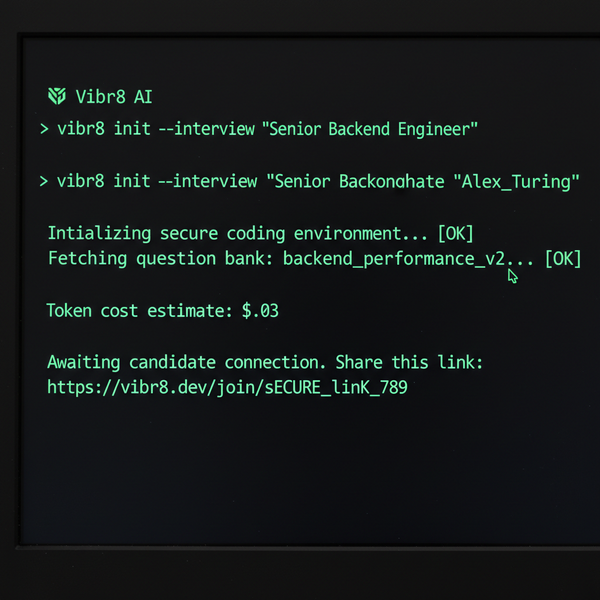
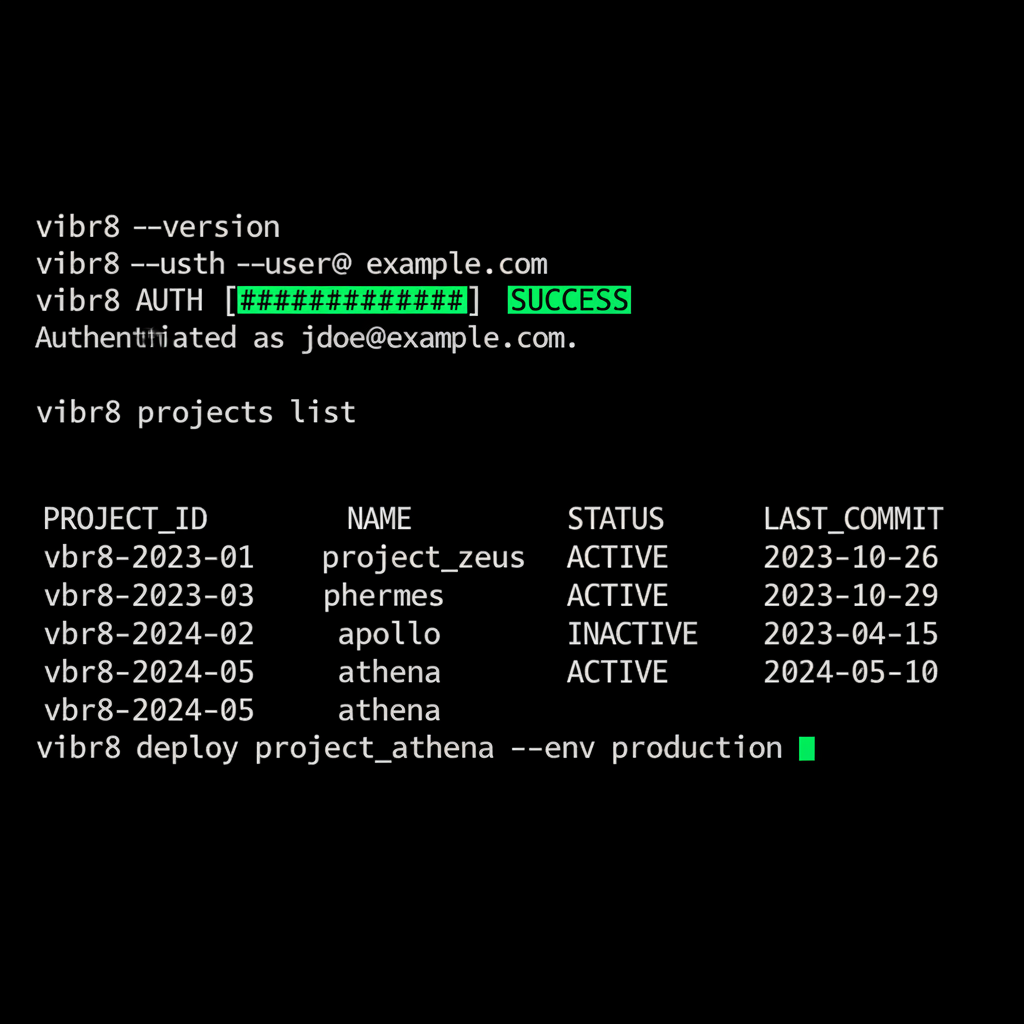
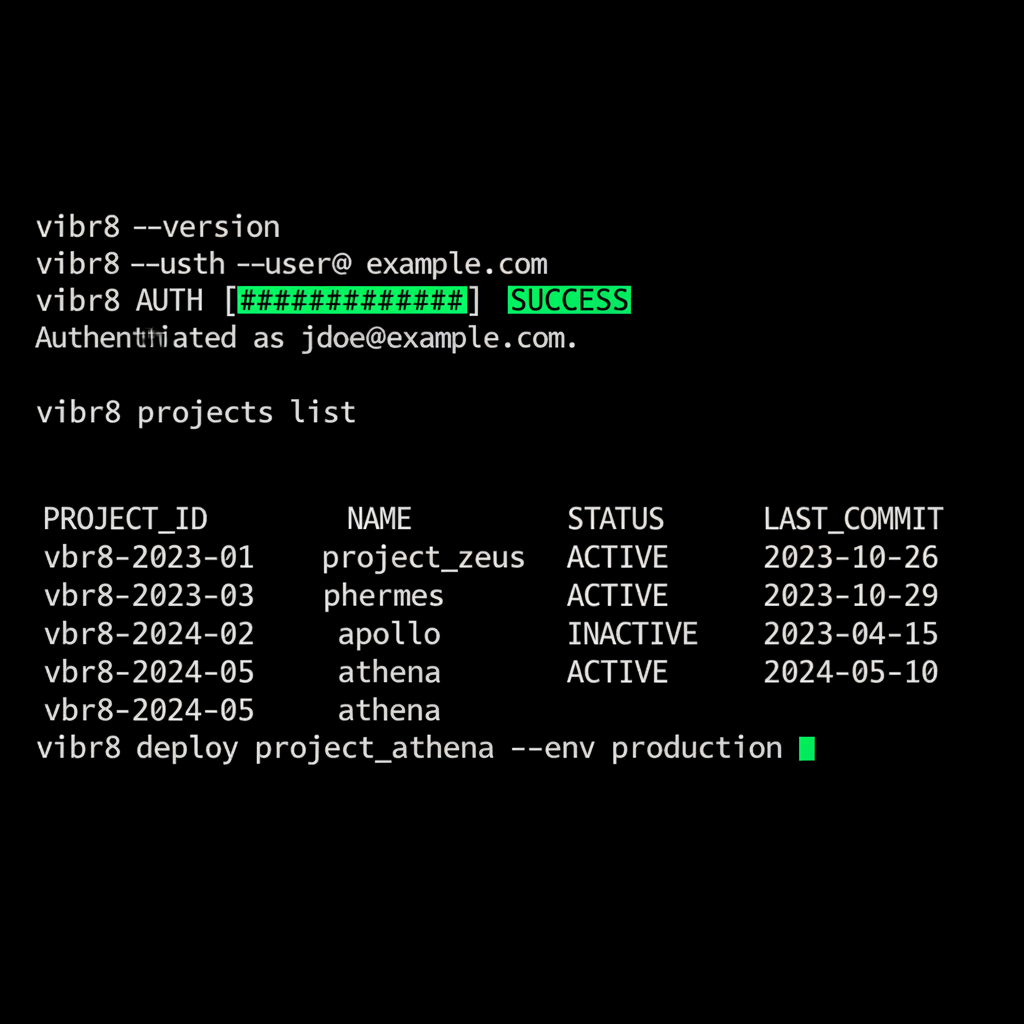
Vibr8’s CLI-native approach is designed to capture this signal in its purest form. By having candidates run brew install vibr8 and work directly in their local terminal, we remove the "artificiality" of the browser. They use their own shortcuts, their own IDE, and their own mental models.
Because the session runs on the Vibr8 API token, we capture every interaction: every prompt, every file touched, and every agent response. We don't just observe the candidate; we record the telemetry of their thought process.
Your Next Hire Comes with a Subscription Fee
There is a hidden variable in every offer letter you sign today: the candidate’s projected compute cost. In 2025, an engineer's salary is only part of their cost to the company. The other part is their token usage.
Consider this scenario from our early pilot data:
- Candidate A solves a real-world GitHub issue in 45 minutes. They provide high-context prompts, verify changes incrementally, and reach the solution with a total token cost of $0.85.
- Candidate B solves the exact same issue in 40 minutes. However, they use "lazy" prompting, asking the agent to "fix the error" repeatedly without providing context. They reach the solution, but the session costs $7.40.
On the surface, Candidate B looks faster. In reality, Candidate B is an architectural liability whose lack of precision will cost you thousands of dollars in wasted compute and technical debt over the next year.
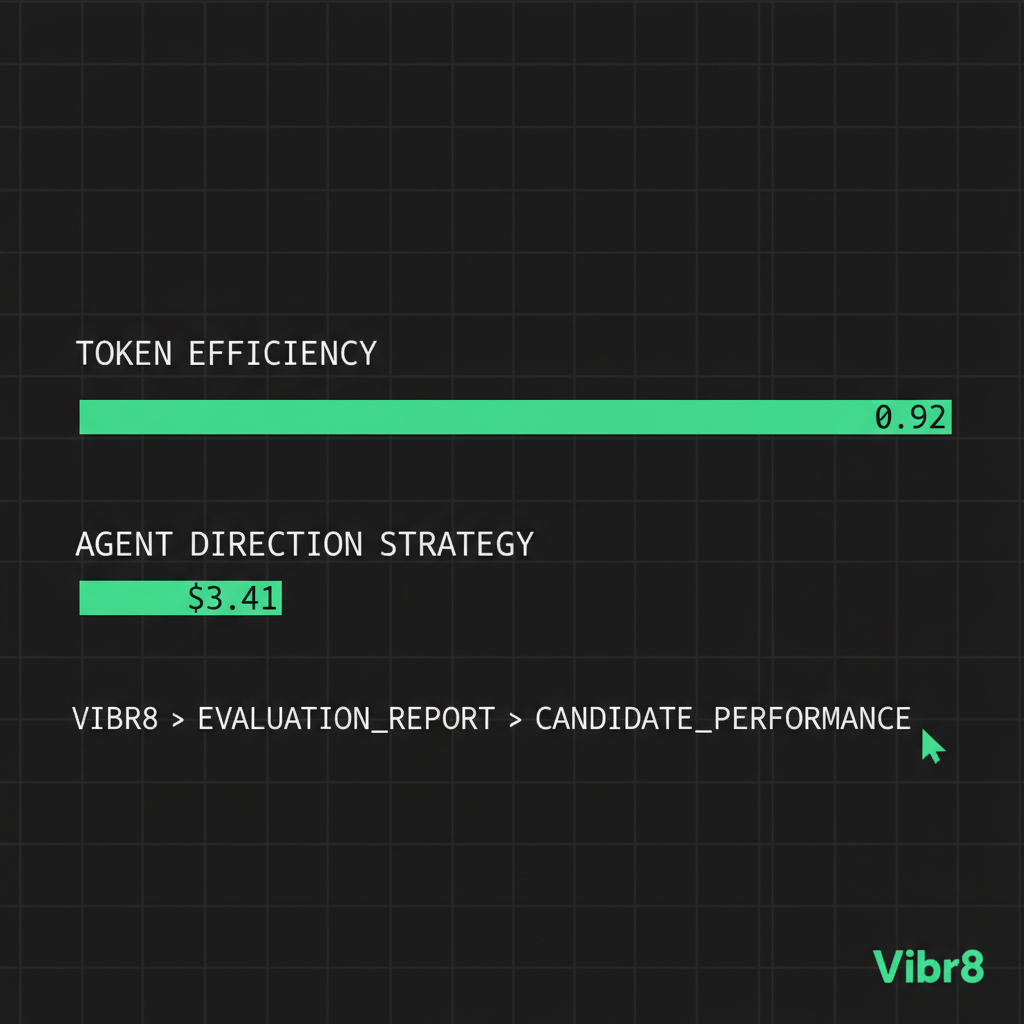
Token efficiency is the new proxy for architectural clarity. An engineer who understands the codebase doesn't need to ask the agent to "explain everything." They know exactly what context to feed the model to get the right output. Vibr8 provides exact passthrough billing for every interview session, giving you a literal dollar figure for a candidate's performance. For the first time, you can see the ROI of a hire before they even start.
The Agentic Shift: 2026 vs. 2022
The software engineering landscape has shifted more in the last 24 months than in the previous decade. In 2022, the IDE was the center of the universe. In 2026, the IDE is gathering dust while the terminal and the agent become the primary interfaces.
Legacy platforms adding an "AI Sidebar" is like putting a motor on a horse-drawn carriage. It’s an old framework trying to contain a new technology. Vibr8 was built from the ground up for the agentic shift. We don't want to see if a candidate can write a function; we want to see if they can navigate a real, messy codebase using the tools of the future.
Our CLI-first approach allows candidates to work on real GitHub issue challenges—not puzzles. They clone the repo, they run the tests, they interact with the agent, and they submit their PR—all through the terminal. It’s the most honest technical interview on the market because it is the only one that mirrors the actual job.
Conclusion: See the Data for Yourself
The "hiring gap" is widening. While candidates are getting better at using AI to pass traditional interviews, engineering leaders are finding it harder than ever to distinguish between a "prompt engineer" and a true "agent orchestrator."
Don't wait until your Anthropic bill spirals out of control to realize you’ve hired the wrong person.
We are currently inviting engineering leaders at Series A-C startups to join our Free Pilot Program.
- Zero platform fees.
- We cover the AI token costs.
- Run one real candidate through a Vibr8 session.
- Receive a comprehensive behavioral and cost report.
Experience what it’s like to have actual telemetry on your hiring process. Stop measuring the solution and start measuring the conductor.
Try Vibr8 for Free – Install via npm and run your first session today.